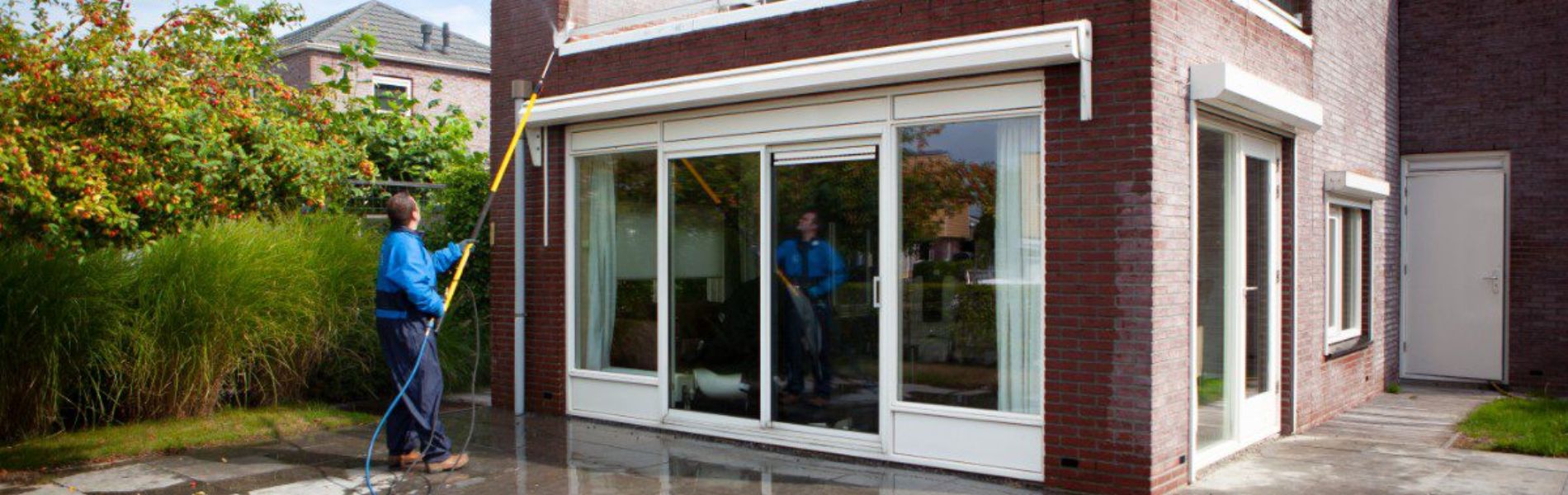
Facade Cleaning and Waterproofing
Impregnating a facade sounds like a simple solution: apply a treatment to the wall, and your facade will keep moisture out. In practice, things often go wrong—and usually for the same reason. People treat a facade that isn’t clean yet, or they choose to do so even though their facade won’t benefit from it at all. In this article, you’ll learn what treatment does, what the drawbacks are, the proper order of steps, and how much it costs per square meter.
What is facade impregnation?
Facade impregnation involves applying a treatment that penetrates the masonry and makes the pores water-repellent. It does not form a film on the surface of the brick, but adheres to the inside of the pore walls. As a result, rainwater beads up and rolls off instead of being absorbed.
The key feature is that a good impregnating agent remains vapor-permeable. The facade repels water from the outside, but moisture from the inside can still escape. A facade coating or wall paint does not do this: it seals off the brick. Siloxane- or silane-based impregnation keeps the facade breathable, and that difference determines whether you’re helping or actually damaging your wall.
Why Cleaning Always Comes Before Waterproofing
This is the mistake we encounter most often. Someone sees a dirty facade, hears that impregnation provides protection, and applies the product to the existing surface. The product then seals in the dirt, algae, and moss spores; it no longer absorbs properly because the pores are clogged, and the growth underneath simply continues.
It’s difficult to fix this. You can’t just clean over it, because the coating repels both water and cleaning agents. In the worst-case scenario, you’ll be stuck with a dirty facade that stays that way for ten years.
The order is therefore non-negotiable: first clean the facade, then apply the impregnating agent. A clean, dry stone absorbs the agent evenly, and that is precisely how it works. Facade cleaning and impregnation should therefore be part of a single process, with a drying period in between.
What are the disadvantages of impregnating a facade?
Impregnation is often marketed as having no downsides. That’s not true. You should be aware of these drawbacks before making a decision.
- Moisture can become trapped. If there is already moisture in the wall—such as rising damp or a leak—you’ll be trapping it. The moisture will then seek another way out, usually inward.
- It can't be undone. The waterproofing agent is embedded in the stone and won't come out. A wrong choice will have lasting effects for years.
- Existing defects will not be resolved. Cracks, loose mortar, and moisture penetration will persist. Impregnation will, at best, only temporarily mask them.
- It doesn't last forever. Its lifespan is typically between eight and fifteen years, depending on the substance and the location. After that, its effectiveness diminishes.
- Using the wrong materials can seal off the facade. If you choose a product that isn't vapor-permeable, you'll trap moisture inside instead of keeping it out.
- It’s risky when it comes to historic buildings. Old masonry and soft brick react differently. Heritage agencies often advise against impregnation in such cases.
In short: impregnation protects a healthy facade and worsens a damaged one.
We make sure that a building facade is cleaned properly
When does impregnation actually make sense?
The most common issue is moisture penetration in a solid wall without a cavity. Rain driven by the wind against the facade seeps through the stone and causes moisture stains inside. A water-repellent treatment stops this capillary action. A west-facing facade—which, in the Netherlands, is exposed to the most driving rain—also benefits from this treatment. The same applies to a freshly cleaned facade that you want to keep clean longer: water that rolls off carries dirt away and makes it harder for algae to take hold.
If you are considering cavity wall insulation, waterproofing is often a prerequisite. Insulation material in a damp cavity loses its effectiveness and can develop mold. A dry exterior wall is essential.
How does facade impregnation work?
The application is less complicated than the preparation. This order determines the result.
- Inspect the facade. Check for cracks, loose mortar, rising damp, and peeling paint. Repairs always take priority.
- Clean the facade thoroughly. Dirt, algae, and moss must be removed, right down to the pores.
- Let the facade dry. Allow at least two to three dry days. A damp brick will not absorb the treatment.
- Cover anything that shouldn't get wet. Window frames, glass, plants, and pavers should be covered with plastic sheeting.
- Apply the product wet-on-wet. Work from the bottom up and keep the surface saturated so that no dry edges form.
- Check the coverage. A second coat is often necessary for porous surfaces. After curing, sprinkle water on the facade: if it beads up, it’s good.
Never work in direct sunlight, in freezing temperatures, or when rain is expected. The product must be absorbed into the stone; it should not evaporate or be washed away from the surface.
Can you waterproof your exterior wall yourself?
You can impregnate a facade yourself, provided it’s a low facade with sound masonry and you prepare it properly. The product is readily available, and applying it with a low-pressure sprayer doesn’t require specialized skills. Things usually go wrong in three areas.
First, cleaning: a facade that looks clean often isn’t clean deep down in the pores. Second, the amount. Allow for half a liter to one and a half liters per square meter; if you use too little, the facade will only be partially protected, and you won’t notice that until years later when stains appear. Third, the height: anything above the first floor requires scaffolding or an aerial lift, and at that point, doing it yourself becomes more expensive than hiring a professional.
First, grout; then, clean; then, seal
Jointing and waterproofing a facade go hand in hand. The joints are the weak point of any facade: if they are worn out or soft, water will seep in right there, no matter how well the brick itself has been treated.
The correct order is therefore: first repair the joints, let them cure, then clean the facade, and finally apply the waterproofing. If you reverse this order, you’ll be impregnating a facade that will subsequently be broken open again for the joint repair. Would you like to have the facade cleaned first and decide later whether to impregnate it? That’s perfectly fine, provided you make a decision within a few weeks and don’t let the facade get dirty again.
How much does it cost to waterproof a facade per square meter?
The cost of impregnating a facade ranges from 10 to 25 euros per square meter when you hire a professional. For a townhouse, that comes to between 900 and 2,200 euros. If you do it yourself, you’ll only pay for the treatment: roughly 5 to 15 euros per square meter.
The cost of impregnating the facade is separate from the cleaning. Facade cleaning costs between 8 and 20 euros per square meter. If you have your facade cleaned, repointed, and impregnated as part of a single project, the total price is usually more affordable than three separate jobs, because the scaffolding or aerial work platform only needs to be set up once.
Four factors determine the price: the number of square meters, the stone’s porosity, accessibility, and the chosen product. A siloxane cream costs more per liter than a liquid product, but it penetrates deeper.
Outsourcing Cleaning and Waterproofing
Our specialists assess the material, the grout, and the level of soiling, and will be honest with you if impregnating your facade won’t be very effective. We’d rather not sell you a treatment at all than sell you the wrong one. We do, however, offer cleaning services: soft wash, steam, high-pressure, or chemical cleaning, tailored to your material. Check out our facade cleaning page for methods and rates, or combine it with paving, exterior, and balcony cleaning for a complete exterior cleanup.

